Christmas Night Whispers
I. The Realm of the Kitchen and Grandmother’s Altar
In the twilight of the kitchen, the old cast-iron stove, black and imposing, reigned like a domestic idol. It hummed softly, exhaling a complex scent that was the very signature of the house: a mixture of hot iron, burning beechwood, and the aroma of a festive stew waiting under its copper lid.
Grandmother, her hands white with flour and her face flushed by the fire, was busy around the sideboard. That was where she had set up the Nativity scene. It was an entire miniature world: the fresh moss, still damp, gave off an earthy fragrance that contrasted with the dry scent of golden straw. Every terracotta figurine had its name and its scar. The most precious was a humble shepherd, the "Ravi," with an arm glued back together with yellowed pine resin. "It was your great-grandfather who mended him in 1944," she would say. This wounded santon seemed to watch over the family secret, a silent witness to the Christmases of the war.
II. The Secret of the Bell Tower and the Walk into the Night
When evening came, the air grew so pure it felt as though it might shatter like glass. Grandfather told once more the story of that Christmas in the 1940s when silence was not a choice, but an act of resistance. To prevent the occupiers from melting down the sacred bronze, the village men had lowered the bells in secret. "We could hear only the friction of the ropes and our short breaths," he would say. They had been buried under the flagstones of the barn. That night, as we left the house, the first strike of the bell tearing through the night resonated like a recovered victory.
III. The Sacristy and the Mystery of the Old Priest
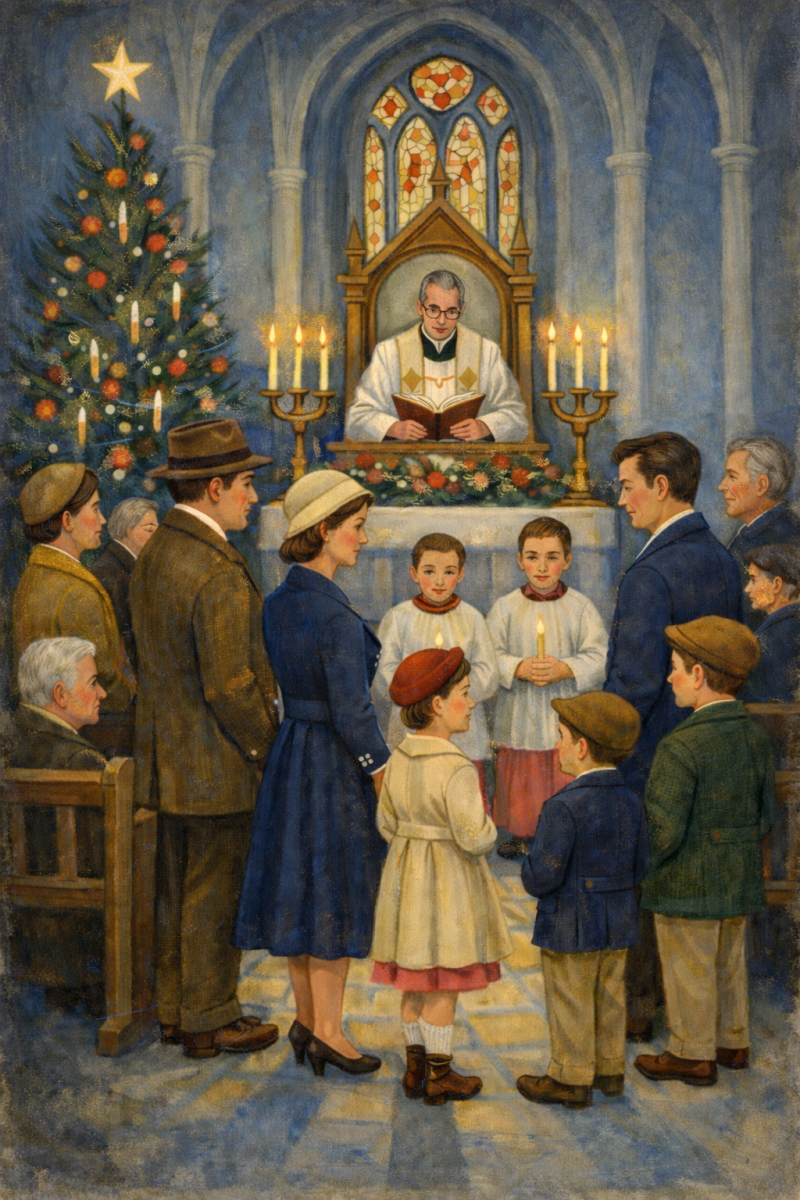
The church vibrated with the light of hundreds of candles. In the sacristy, the old priest, with a face carved like ancient parchment, officiated with a solemnity that was as chilling as it was reassuring. His hands, dry and strong, readjusted the starched collars of the choirboys, transformed into little angels in their red robes. "The Good Lord is watching you, my little ones," he would whisper. The incense smoke began to rise in blue swirls, mingling with the scent of the moss decorating the altar.
IV. The Christmas Feast: A Banquet of Warmth and Butter
The return home after Midnight Mass was an explosion of life. The old stove, a faithful guardian, had kept the meal just right. We would sit around the large farmhouse table, and plates were filled with white boudin sausage and preserved meats. Then came the sacred moment of the Yule log: a monument of chocolate buttercream, textured with a fork to mimic the bark of the oaks. Every child watched for the slice that held the little plastic gnome or the miniature saw.
V. The Dawn of Simple Treasures
The next morning, the world felt new. The children crept down the stairs, their bare feet seeking the warmth of the floor tiles. There, before the last dying embers, the miracle had occurred. In every shoe, placed against the warm stone of the hearth, shone an orange. For those children of the 40s and 50s, this fruit was the winter sun, an absolute rarity. We would dig a nail into the thick skin to release that zesty scent that instantly erased all the year's hardships.
Epilogue: The Scent of Eternity
Today, the soul of those Christmases of old refuses to fade away. The priest, the stove, the mended arm of the santon... it all forms an invisible chain. Christmas, at its heart, is not a date on a calendar; it is that moment of grace when the scent of an orange and the warmth of a memory whisper to us that we belong to the same human story—beautiful and indestructible.
Les Murmures de la Nuit de Noël
I. Le Royaume de la Cuisine et l'Autel de Grand-Mère
Dans la pénombre de la cuisine, la vieille gazinière en fonte, noire et imposante, régnait comme une idole domestique. Elle ronronnait doucement, exhalant une odeur complexe qui était la signature même de la maison : un mélange de fer chaud, de bois de hêtre qui se consume et de ce fumet de ragoût de fête qui patientait sous son couvercle de cuivre.
Grand-mère, les mains blanches de farine et le visage rougi par le feu, s'affairait autour du buffet. C'est là qu'elle avait dressé la crèche. C’était tout un monde miniature : la mousse fraîche, encore humide, dégageait un parfum de terre qui contrastait avec l'odeur sèche de la paille dorée. Chaque personnage de terre cuite avait son nom et sa cicatrice. Le plus précieux était un humble berger, le "Ravi", au bras recollé avec une résine de pin jaunie. « C'est votre arrière-grand-père qui l'a soigné en 1944 », disait-elle. Ce santon blessé semblait veiller sur le secret de la famille, témoin muet des Noëls de guerre.
II. Le Secret du Clocher et la Marche vers la Nuit
Le soir venu, l'air devint si pur qu'il semblait pouvoir se briser comme du verre. Le Grand-père raconta une fois de plus ce Noël des années 40 où le silence n'était pas un choix, mais une résistance. Pour éviter que l'occupant ne fonde le bronze sacré, les hommes du village avaient descendu les cloches en secret. « On entendait juste le frottement des cordes et nos respirations courtes, » disait-il. Elles avaient été enterrées sous les dalles de la grange. Ce soir, en sortant de la maison, le premier coup de cloche qui déchira la nuit résonna comme une victoire retrouvée.
III. La Sacristie et le Mystère du Vieux Curé
L'église vibrait de la lumière des centaines de cierges. Dans la sacristie, le vieux curé, au visage taillé dans un parchemin ancien, officiait avec une solennité qui glaçait autant qu'elle rassurait. Ses mains, sèches et fortes, réajustaient les cols empesés des enfants de chœur, métamorphosés en petits anges dans leurs aubes rouges. « Le Bon Dieu vous regarde, mes petits, » murmurait-il. La fumée de l'encens commençait à s'élever en volutes bleues, se mélangeant à l'odeur de la mousse décorant l'autel.
IV. Le Réveillon : Un Festin de Chaleur et de Beurre
Le retour au foyer était une explosion de vie. La vieille gazinière avait maintenu le repas à point. On s'installait autour de la grande table de ferme et les assiettes se remplissaient de boudin blanc et de viande confite. Puis venait le moment sacré de la bûche de Noël : un monument de crème au beurre chocolatée, travaillée à la fourchette pour imiter l'écorce des chênes. Chaque enfant guettait la part qui portait le petit nain en plastique ou la scie miniature.
V. L'Aube des Simples Trésors
Le lendemain matin, le monde semblait neuf. Les enfants descendaient l'escalier à la dérobée, leurs pieds nus cherchant la tiédeur des tommettes. Là, devant les dernières braises, le miracle s'était produit. Dans chaque soulier, posé contre la pierre chaude de l'âtre, brillait une orange. Pour ces enfants des années 40 et 50, ce fruit était le soleil de l'hiver, une rareté absolue. On enfonçait l'ongle dans la peau épaisse pour libérer ce parfum zesté qui effaçait toutes les privations de l'année.
Épilogue : Le Parfum de l'Éternité
Aujourd'hui, l'âme de ce Noël d'autrefois refuse de s'éteindre. Le curé, la gazinière, le bras recollé du santon... tout cela forme une chaîne invisible. Noël n'est pas une date sur un calendrier, c'est ce moment de grâce où l'odeur d'une orange et la chaleur d'un souvenir nous murmurent que nous appartenons à une même histoire humaine, belle et indestructible.